Revealing Network Effects in Player Collaboration Within Evolving Browser Puzzle Environments
Written by Greta Otto · Jun 21, 2026
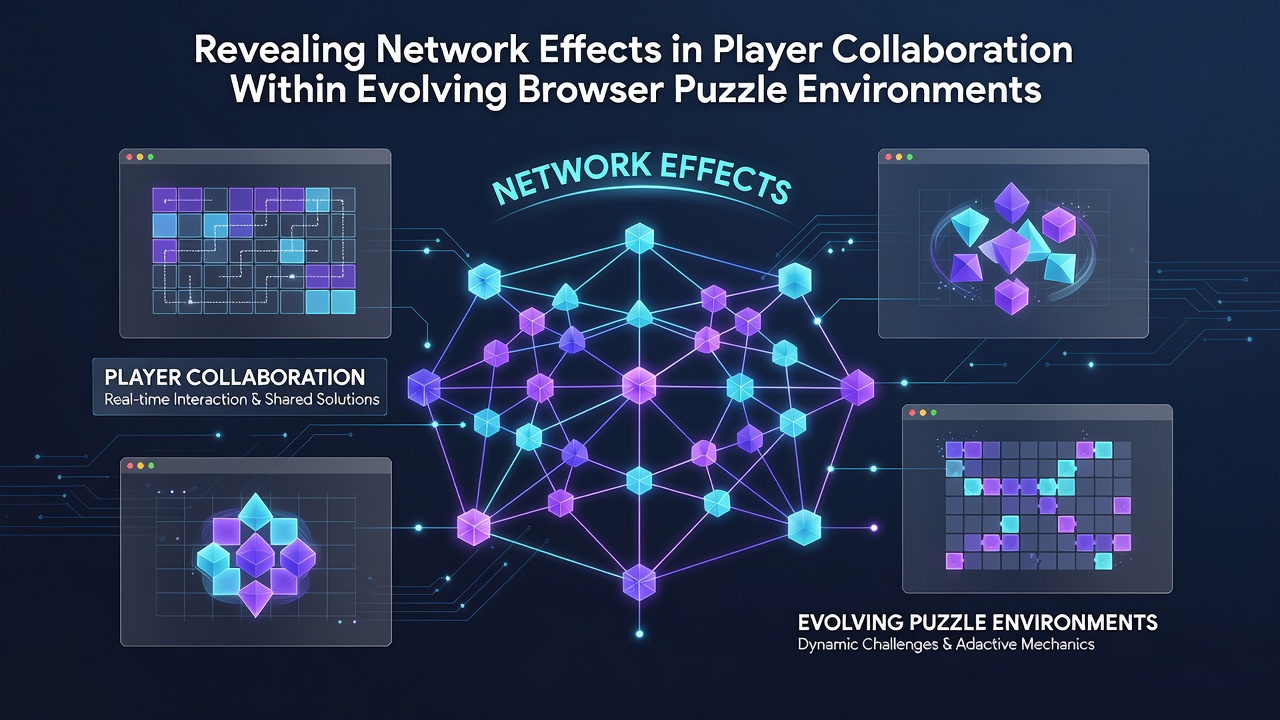
Revealing Network Effects in Player Collaboration Within Evolving Browser Puzzle Environments
Browser puzzle environments have expanded rapidly since their early iterations, and data from multiple tracking platforms indicate that player numbers directly influence how collaboration forms around shared challenges, where each additional participant expands the pool of possible solution paths and resource exchanges. Observers note that these platforms often feature puzzles that update in real time based on collective input, creating feedback loops in which early contributions shape later opportunities for others.
Core Mechanisms Behind Network Growth
Network effects emerge when the utility of a system rises with user count, and in puzzle contexts this appears through shared workspaces where one solver's progress reduces the search space for everyone else, according to analyses from the Digital Games Research Association. Researchers have mapped these patterns by logging interaction timestamps across thousands of sessions, revealing that groups exceeding a certain threshold complete layered puzzles faster because redundant efforts drop and specialized roles solidify naturally. Yet the same datasets show that below that threshold isolated players often repeat work already handled elsewhere, which slows overall advancement.
Platforms running these environments record session data that highlights how connection density grows exponentially once a critical mass of active accounts logs in during peak hours, and figures from industry reports compiled by the Entertainment Software Association confirm similar scaling in North American browser titles released between 2023 and 2025.
Collaboration Patterns Observed Across Platforms
Players frequently form temporary clusters around specific puzzle nodes, passing partial solutions through in-game chat or shared annotation tools, while larger populations allow subgroups to tackle parallel branches without interference. Studies tracking participation logs indicate that repeat visitors return more often when their previous contributions appear in subsequent updates, reinforcing a cycle where visible impact encourages further engagement. Data collected through June 2026 continues to show that environments releasing weekly content patches sustain higher daily active users precisely because prior network density carries over and accelerates new puzzle resolution rates.

One documented case involved a European-hosted puzzle suite where regional time-zone overlaps produced distinct collaboration spikes, and researchers at the Interactive Software Federation of Europe later correlated those spikes with measurable drops in average completion time per stage. The same report notes that cross-region linking features further amplified the effect by allowing asynchronous handoffs between clusters active at different hours.
Data Trends and Measurement Approaches
Analysts employ graph-theory models to quantify how player nodes connect through shared puzzle states, counting edges that represent direct assistance or indirect benefit from another user's actions. These models reveal that degree centrality rises sharply after the first week of a new environment launch, provided onboarding tutorials guide newcomers toward existing clusters rather than solitary exploration. Metrics published in peer-reviewed proceedings from academic conferences demonstrate that environments with visible contribution histories retain users longer than those that obscure individual inputs, because newcomers can identify high-value collaborators more quickly.
Longitudinal tracking across multiple titles also shows seasonal fluctuations, with summer months often producing denser networks due to increased leisure time, and these patterns hold steady into mid-2026 according to aggregated telemetry shared by several development studios. The resulting density supports more complex puzzle layers that would otherwise remain unsolved in smaller populations.
Implications for Platform Design
Design teams adjust matchmaking and grouping algorithms to capitalize on emerging network density, inserting prompts that route solitary players toward active clusters once participation metrics cross predefined thresholds. Such adjustments reduce friction and allow the positive feedback loop to strengthen without external intervention. Observers tracking adoption rates note that titles implementing these adjustments early maintain steadier user curves compared with those relying solely on organic discovery.
Conclusion
Network effects in browser puzzle environments continue to shape how collaboration scales, with measurable impacts on completion speed, retention, and content complexity as participant counts rise. Ongoing data collection through 2026 and beyond supplies clearer models for predicting when these effects reach critical mass, giving developers concrete benchmarks for feature timing and community tooling.